Matériel en vrac standard ou personnalisé
Quoi de mieux pour votre projet ?
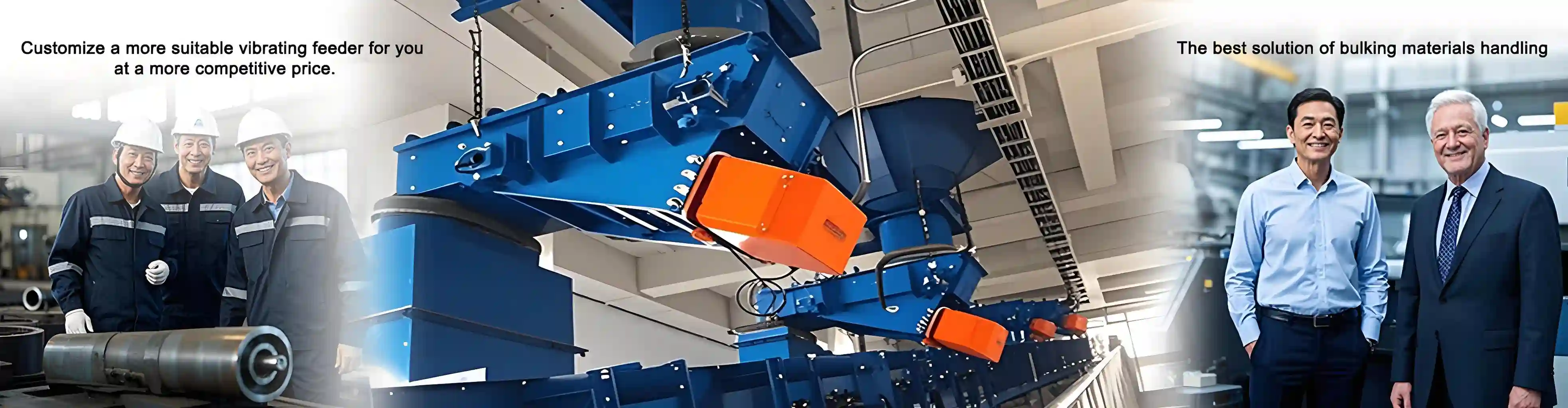
En tant que type d'alimentateur de matériaux en vrac, le alimentateur vibrant Il est largement utilisé dans des industries telles que l'alimentation, l'exploitation minière, le charbon et les matériaux de construction pour le transport de matières premières en vrac en raison de ses avantages tels qu'une efficacité élevée, un faible niveau sonore, une résistance au colmatage, une amplitude/fréquence réglable et l'absence d'entretien.
Pour améliorer l'efficacité de la production d'une usine utilisant un alimentateur vibrant, il est essentiel de comprendre sa structure. Une fois nos besoins clairement définis, nous pourrons obtenir un alimentateur vibrant sur mesure.
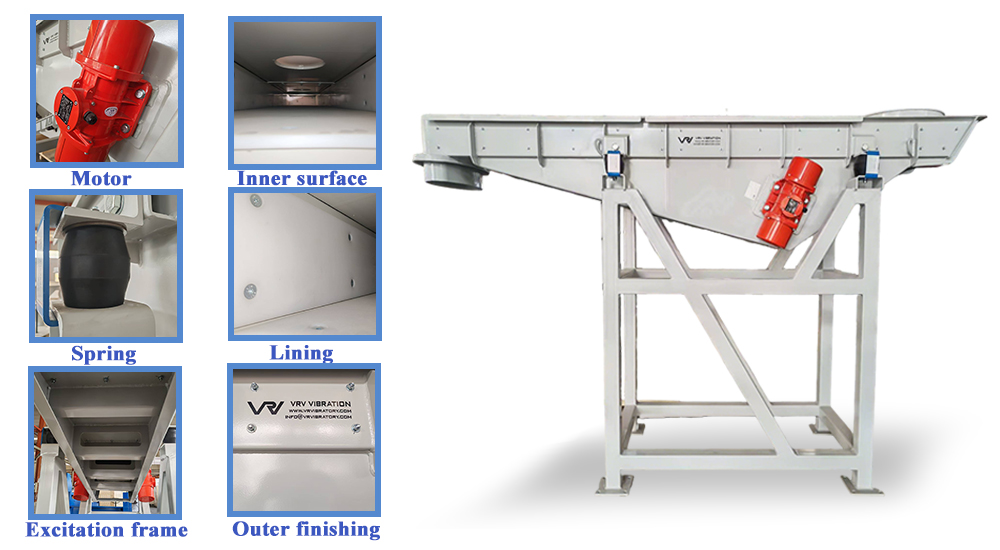
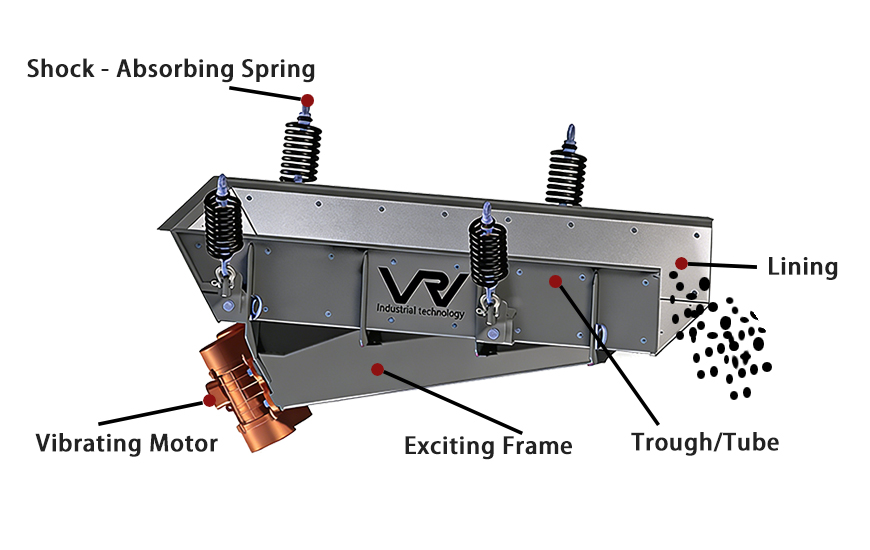
La structure d'un alimentateur vibrant est très simple ; elle se compose principalement d'un moteur vibrant, d'une trémie ou d'un tuyau de convoyage, d'un châssis d'excitation des vibrations, de supports, de ressorts, de revêtements, etc. Pour déterminer la qualité d'un alimentateur vibrant, il est primordial d'examiner attentivement le choix et la conception du moteur vibrant et du châssis d'excitation. Le fabricant doit calculer, en fonction de paramètres tels que la capacité de traitement, la masse volumique et la granulométrie des matériaux en vrac, le moteur vibrant le plus adapté et dimensionner le châssis d'excitation selon l'angle, la longueur, etc.
Moteur vibrant
Le moteur vibrant est l'élément moteur du distributeur vibrant. Il est généralement constitué d'un bloc excentrique à double arbre de sortie. L'amplitude de la force d'excitation est modulable en ajustant l'angle entre les blocs excentriques. Une fois mis en marche, il entraîne l'équipement pour générer des vibrations directionnelles, propulsant ainsi les matériaux vers l'avant dans la goulotte. Sa vitesse de rotation et la force d'excitation déterminent directement l'efficacité du transport et la stabilité d'amplitude du distributeur.
Canal de convoyage / Tuyau
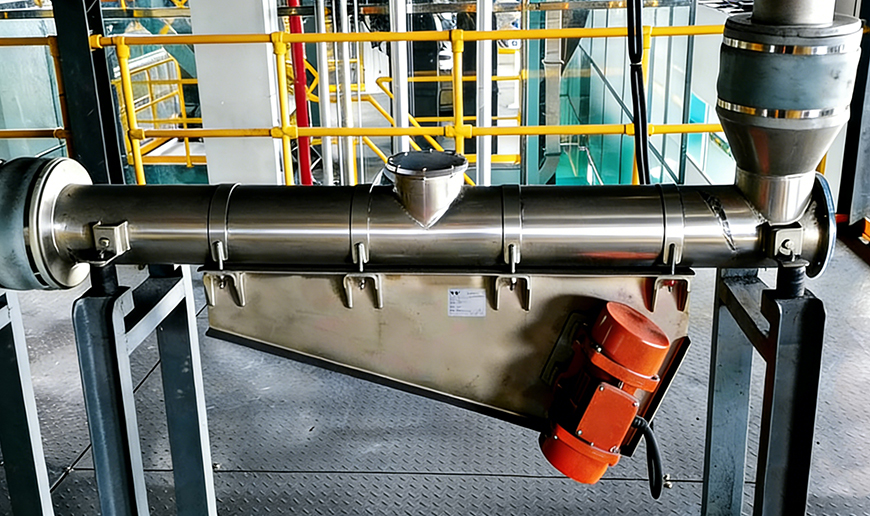
La goulotte (ou conduite de transport) constitue le canal de transport et d'acheminement du matériau dans l'alimentateur vibrant. La goulotte se présente généralement sous forme de cuvette ou de plaque, tandis que les conduites sont plus adaptées au transport en circuit fermé de poudres et de particules fines. Sa forme, sa longueur et son angle d'inclinaison doivent être conçus en fonction des caractéristiques du matériau et des exigences de transport. En fonctionnement, elle effectue un mouvement de va-et-vient avec le système de vibration, assurant ainsi un transport continu par projection ou glissement du matériau. Certaines goulottes sont conçues en sections pour faciliter l'installation et la maintenance.
Vibration - cadre excitant
Le bâti vibrant est l'élément de transmission de force et de liaison du distributeur vibrant. Il est généralement fixé rigidement au moteur vibrant et à la trémie de convoyage. Sa fonction est de transmettre uniformément la force d'excitation générée par le moteur vibrant à toutes les parties de la trémie, assurant ainsi une vibration synchrone de l'ensemble de la trémie et évitant les concentrations de contraintes localisées. Il contribue également à la fixation du moteur vibrant, garantissant sa stabilité d'installation même en présence de vibrations à haute fréquence.
Soutien
Le support constitue la base de support et d'installation du distributeur vibrant. Il sert principalement à fixer l'équipement sur la fondation ou le châssis. Sa structure doit être adaptée au poids total et aux caractéristiques vibratoires du distributeur. Il est généralement conçu en acier soudé ou en acier moulé, et présente une résistance et une rigidité suffisantes pour supporter les charges dynamiques lors du fonctionnement de l'équipement. Certains supports permettent également de régler la hauteur et l'angle d'inclinaison afin de répondre aux différentes exigences d'installation et de convoyage.
Printemps
Le ressort est un élément essentiel pour l'isolation et l'amortissement des vibrations du distributeur vibrant. Installé entre le support et le châssis vibrant (ou la goulotte de transport), il se décline principalement en deux types : les ressorts hélicoïdaux et les ressorts en caoutchouc. En fonctionnement, le ressort supporte le poids propre de l'équipement, absorbe l'énergie vibratoire, réduit la transmission des vibrations à la fondation, prévient la résonance et, grâce à sa déformation élastique, contribue à la stabilité de l'amplitude des vibrations du système.
Doublure
Le revêtement est un élément protecteur et résistant à l'usure, placé sur la paroi intérieure de la trémie de convoyage. Il est généralement constitué de plaques d'acier résistant à l'usure, de polyuréthane, de caoutchouc ou d'autres matériaux résistants à l'usure et aux chocs. Son rôle est de protéger la trémie contre l'abrasion et l'usure directes des matériaux, et d'en prolonger la durée de vie. De plus, différents matériaux permettent d'ajuster le coefficient de frottement entre les matériaux et la trémie, d'optimiser la vitesse et la fluidité du transport, et d'empêcher l'adhérence des matériaux à la paroi.
VRV, un professionnel
fabricant d'alimentateurs vibrants
En Chine, nous personnalisons les alimentateurs vibrants selon vos besoins. Contactez-nous pour obtenir un devis.
appelle-nous :
008617855911791 e-mail : sales@vrvibratory.com


 réseau ipv6 pris en charge